
Sandro Botticelli - Primavera

A mystical evening in Spring - an allegory of nature’s fertility - and a symbol for how Love itself is the foundation of both art and life.
Sandro Botticelli’s “Primavera” is truly one of his most outstanding masterpieces, with a reputation matched only by his equally iconic “Birth of Venus”.
And in being one of the most famous paintings in the world, it has also been the subject of countless books, essays, and interpretations over the centuries - inspiring new ideas amongst every viewer who happens to stray into this magical little garden grove.
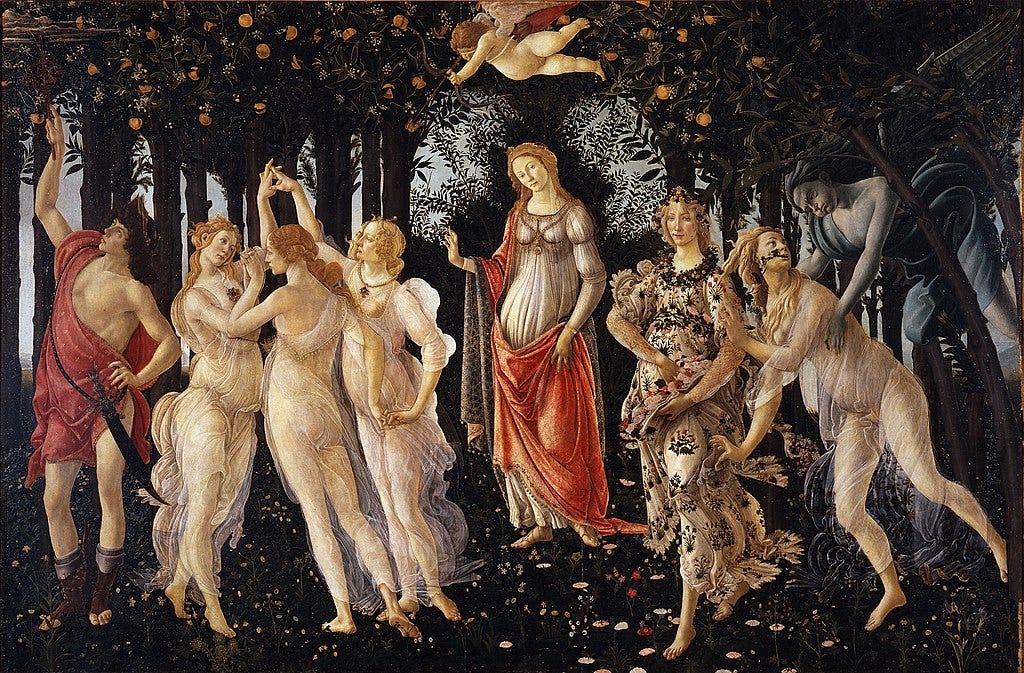
So of course, a single newsletter will never allow us to do full justice to the true depths of this work.
Yet still, no matter if this our first time ever spending time with the work, or if it is our thousandth viewing, there really is always something new to catch our attention here.
So, to start us off today on our short little overview, I want us to follow the painting across from left to right, in order to address a few of the more immediate mysteries.
_
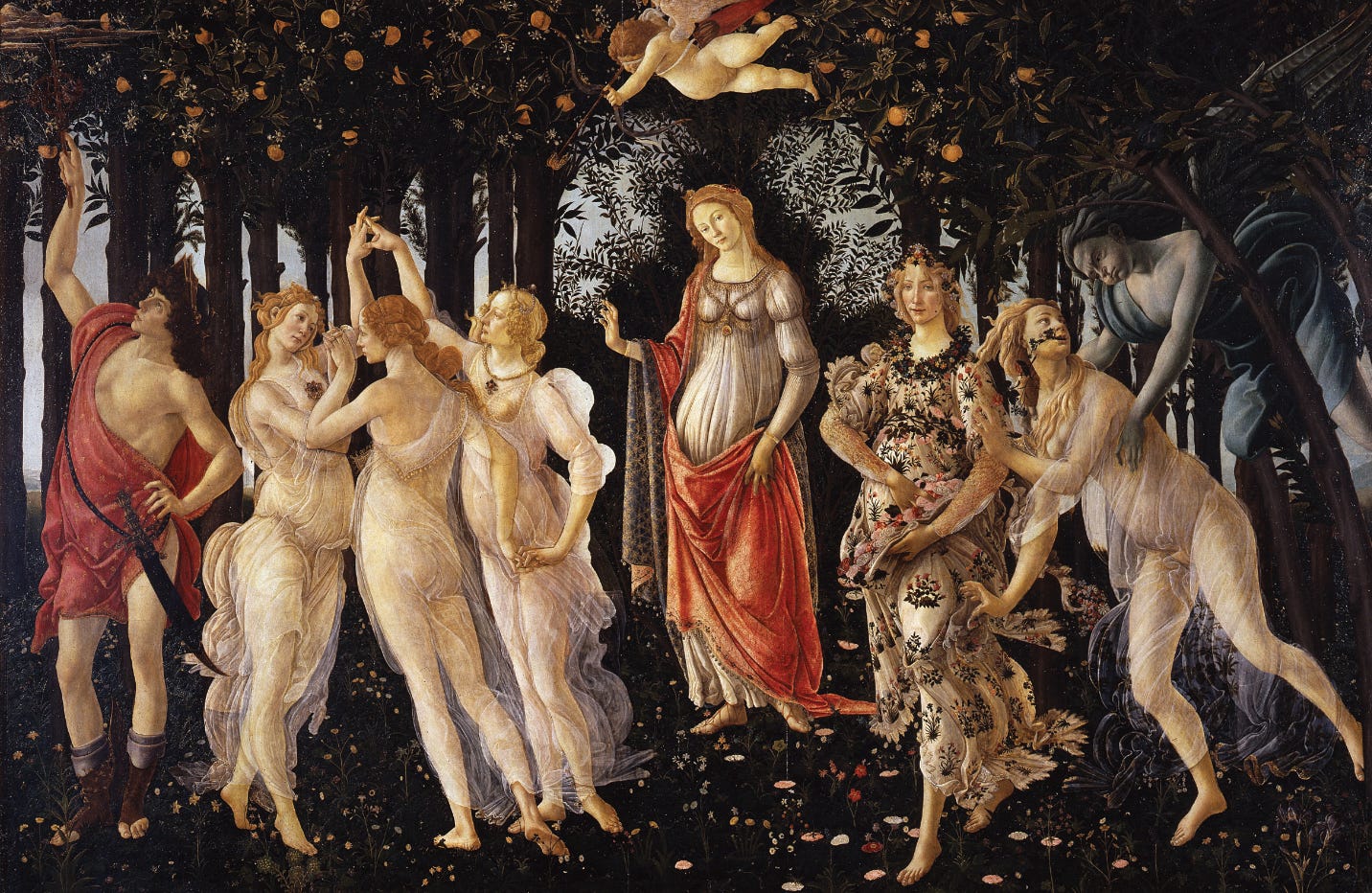
First, we come to a man in red - poking a stick into the treetops above him, and standing in quite an effeminate pose.
At his side, he carries a deadly weapon (which seems highly unnecessary given the company he is in!). And curiously, he has turned his back to all the other figures too - as if entirely uninterested by their presence.
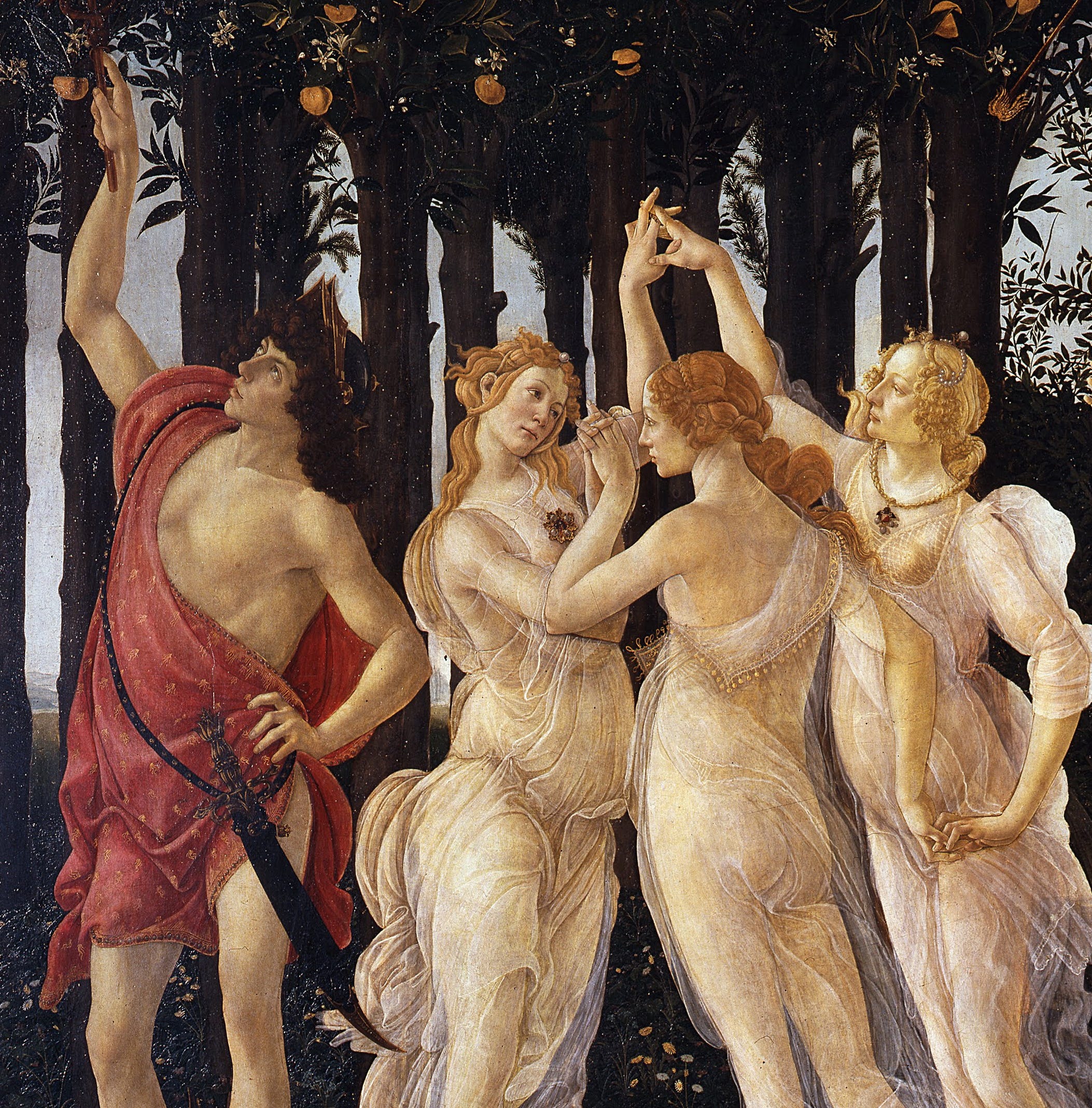
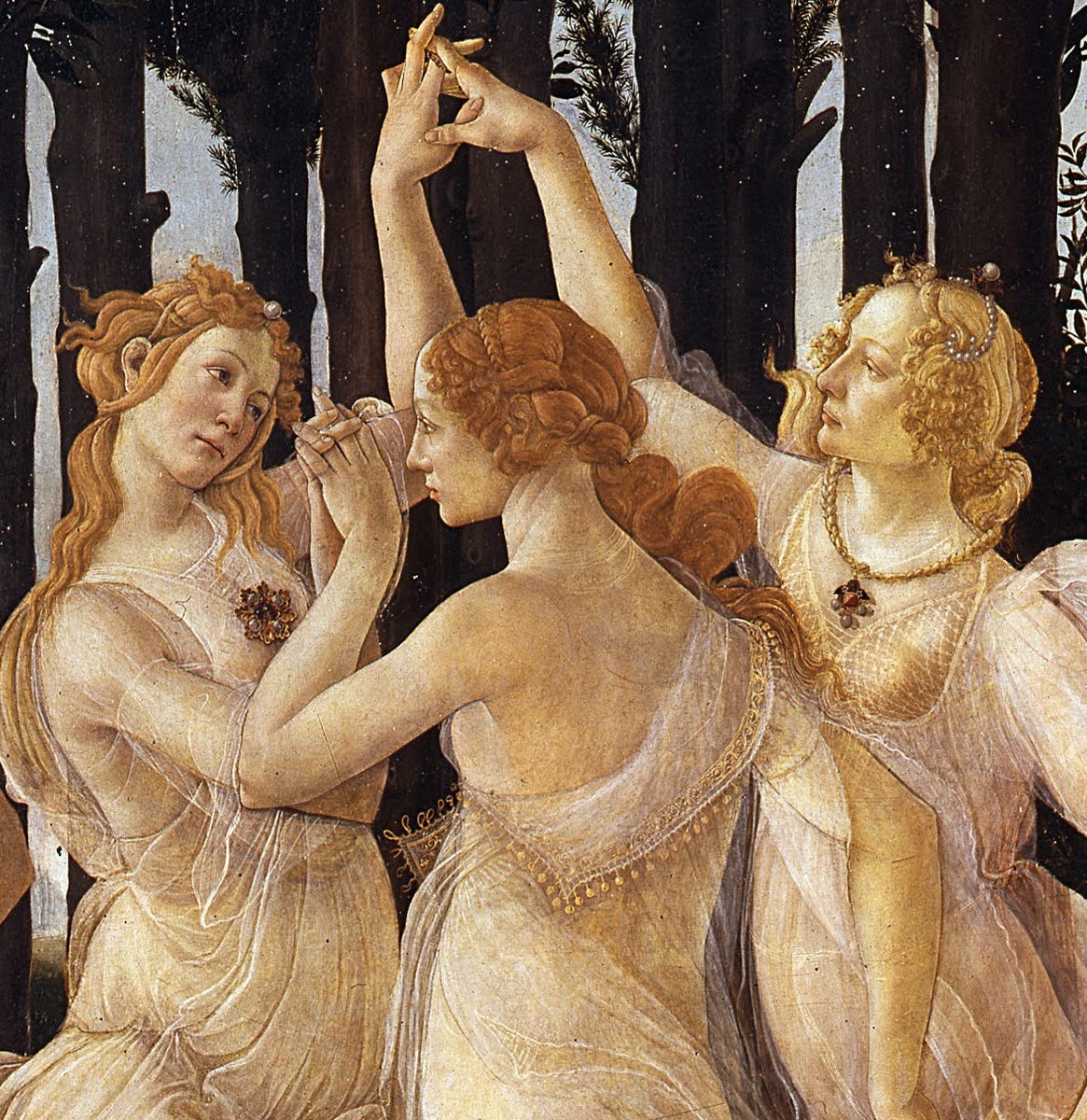
Then, next to him - we have three beautiful women dancing together (again, seemingly lost in their own little world)
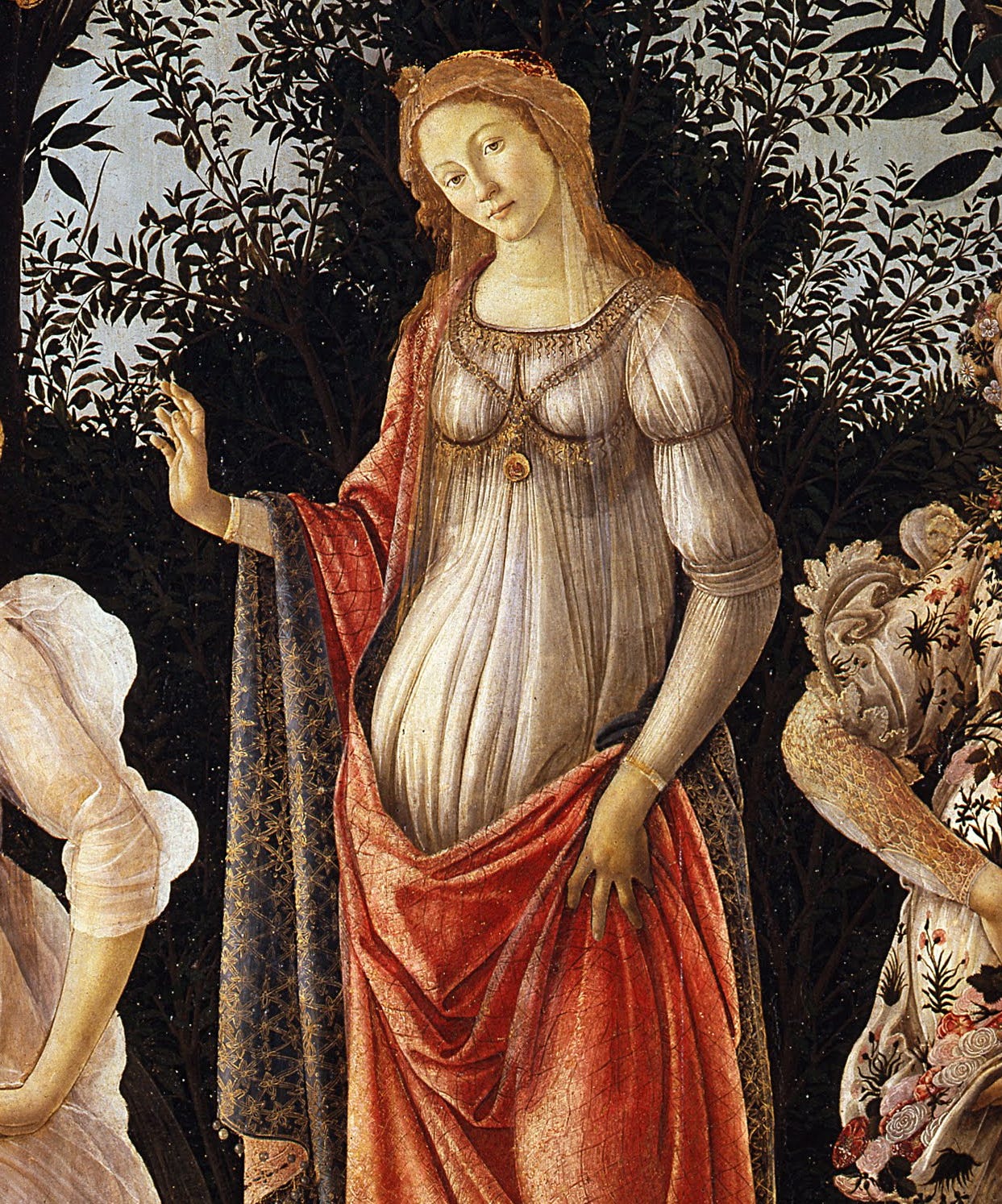
And after this - another beautiful woman at the very centre, looking so magisterial in her royal robes. (Though apparently unaware that a little cherub is soaring over her head)
Then finally, as our eyes now reach the opposite side of the painting from where we started - things start to get even more unusual still.
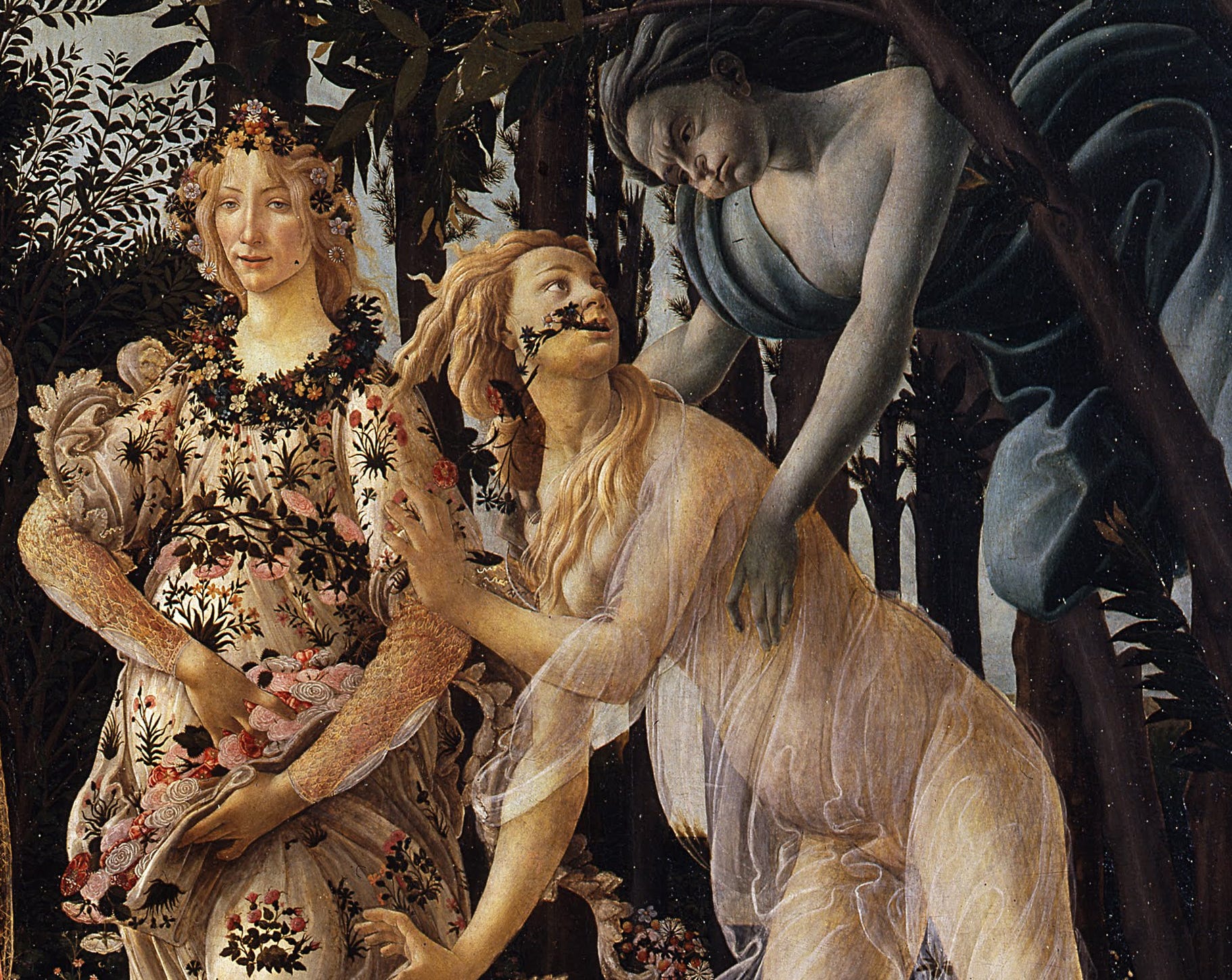
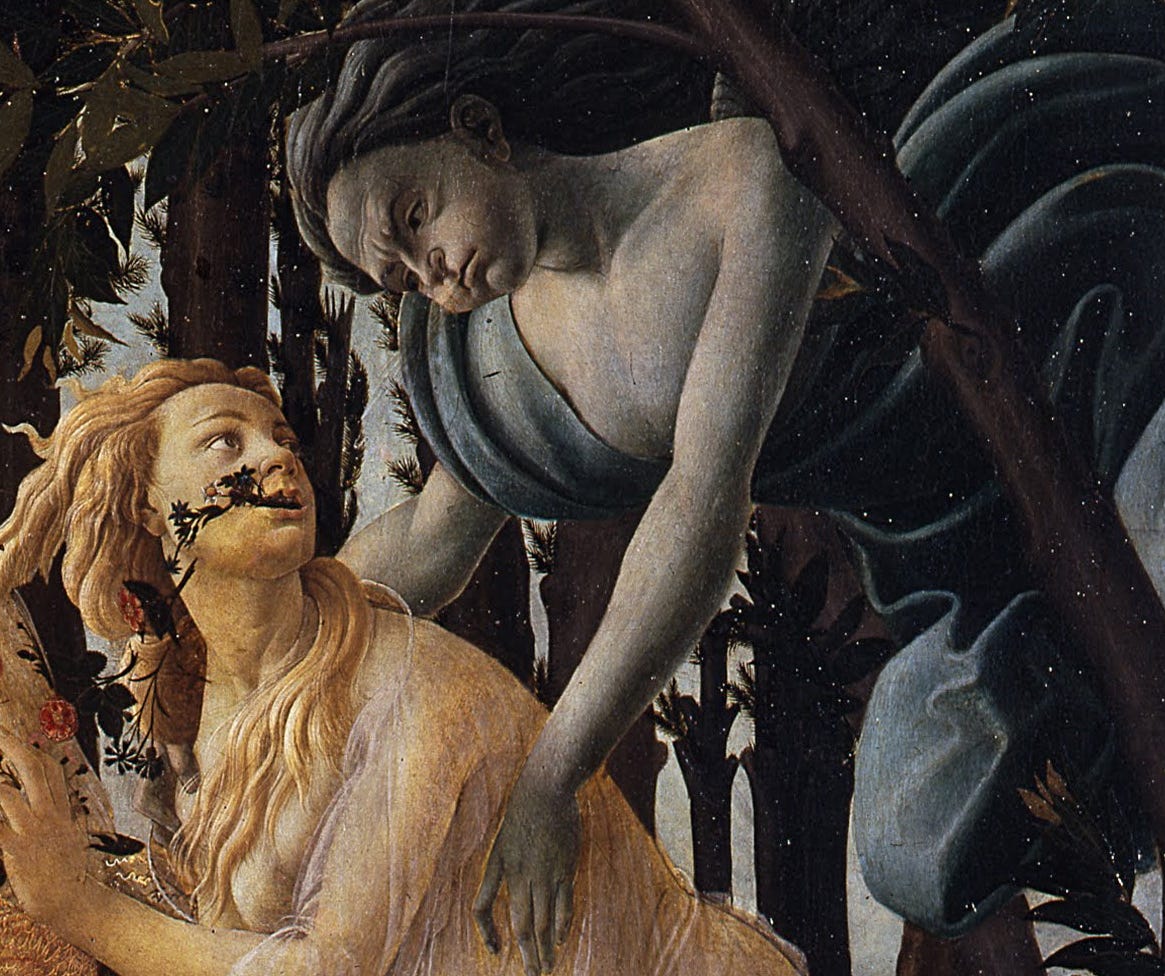
We have a blue figure, apparently trying to kidnap that young woman with flowers in her mouth.
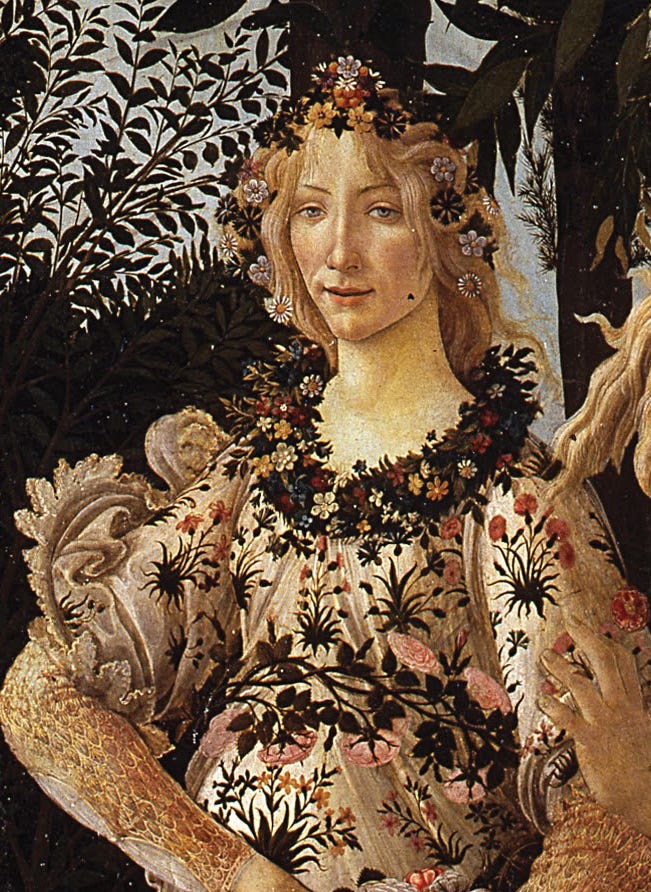
And to the left of them, we have one more enigmatic woman in a floral dress, who appears to be utterly unfazed by the terror of her companion beside her . . . yet is also holding her stomach in such a way that it appears she may well be pregnant.
Now, of course, the main reason for pointing out all these things to begin with is really just to encourage you all to come up with your own ideas as to what it all could mean. (And rest assured, there really are no right or wrong answers here - so please feel free to share any thoughts in our friendly comments section)
But for those of you who may be interested in diving deeper into the mythological elements here too . . . I want us to now run through the painting in the same order again. Only, this time, we will be identifying the characters more fully - and, by extension, perhaps revealing a bit more of Botticelli’s ultimate message here.
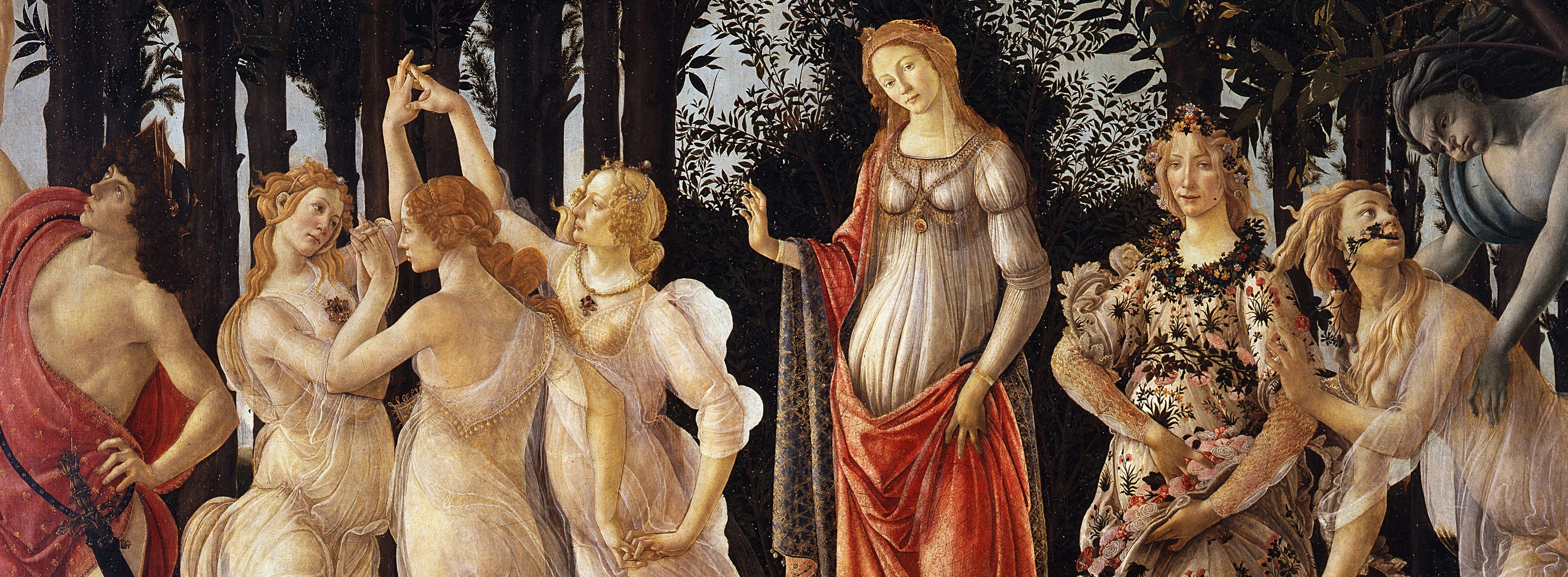
So, to take us back again to the man with the sword on the far left . . . this is the Roman God Mercury. (Who is generally seen as the God of communication, or as a kind of messenger in the same way as Hermes to the Greeks)
Then, next to him are The Three Graces - named Aglaea (”Shining”), Euphrosyne (”Joy”), and Thalia (”To Blossom”).
_
Following this; at the very centre we have Venus - The Goddess of Love.
And above her (as you may have already guessed) is Cupid . . . who, just like Venus, is here to show us that this concept of “Love” is at the very heart of this work.
Then finally, back over to the other side . . . the pregnant woman is Flora (here to more directly personify the concept of Spring, or “Primavera”).
And the young woman next to her is Chloris (a nymph associated with the new growth of flowers in the spring) . . . while the blue character hassling her is Zephyrus (The god of the Wind)
So, with all these characters now identified . . . let’s now try and put some of these pieces together into an interpretation. (Though once again, please remember that this is just one possible option among many!)
_
We know already that the work is called “Primavera” . . . i.e it is a painting to represent the spring.
But in order to capture the true essence of this “primavera” - Botticelli does something very unique in that he aims to show all elements of spring at the same time; from the magical, to the turbulent.
In other words, we each know from our own experiences that spring is a season of transition, just as much as it is a time for new life.
Yes, the flowers start to blossom and bloom again - and the light, warmth and colours of our world all return with such profound beauty. But at the same time, Spring still brings its fair share of dark or dreary days too, when it seems as if winter remains absolutely determined to keep clinging on to us.
And indeed, there are even some days of spring where we might wonder if we have declared its arrival to early . . . or where it seems a few days of promising warmth have regressed straight back into the cold greyness of the previous months.
And this is all a part of what Botticelli is representing with his mythological characters here too.
With Mercury, we find a sceptical messenger, who (like a scientist) wants to poke and prod the trees fully before he is happy to declare spring to really be here.
With the three graces, we have the total opposite to him - and these women are already so convinced spring has arrived, they are dancing in joy to celebrate.
With Flora - we are given a message somewhere in between . . . reminding us that while some parts of spring may indeed have arrived, there is likely far more still to come too. (i.e far more to “be born”, hence her pregnant state.)
With Zephyrus and his icy blue body - we see that a cold breeze is still in the air, and that the chill of winter can still cause more than its fair share of terror to the likes of poor Chloris and her flowers.
And finally, right at the centre of the work, we have Cupid and Venus . . . both here to remind us that Spring itself is ultimately a reflection of Love.
_
After all, just as spring gives birth to to the beauty of nature . . . so too, Love gives birth to the beauty of human nature.
It is love that makes our flowers grow.
It is love that makes our heart feel lighter or warmer.
It is love that makes us feel so enchanted by the magic of a changing season (or the wonder of a painted masterpiece!)
And to paraphrase Dante Alighieri (a man who Sandro Botticelli himself was a great admirer of) . . . it is love which moves the sun and all the stars.
Quick note: As a solo writer with no other means of support, it takes a great deal of time to write long form articles like this. So a special thanks to all of you who do subscribe with a paid option. All your contributions really do make a world of difference in helping to keep this newsletter going.
Women painted by Botticelli, namely Zipporah, daughter of Jethro and then wife of Moses, are the inspiration for describing the face of Swann's obsessive love Odette in Proust. The Venus in Primavera is similar in type to Zipporah.
And Swann who is a ladies man typically goes for round and rosy cheeked women, not the Zipporah/ Venus archetype with its almost too thin face. It's an expression by Proust of the mystery of attraction.
Thank you. I will remember Zephyrus whenever an unexpected Spring wind comes through and messes up my garden.