
Raphael - First and Last

Despite his tragically early death at only 37 years old, Raphael is undoubtedly one of the greatest artists of all time. And while he was clearly naturally gifted from a very early age, one of the key elements of his genius was actually his insatiable desire to learn from those around him.
Perhaps more than any other artist of the High Renaissance, Raphael would devote himself to studying the techniques of others (from Leonardo da Vinci’s “sfumato” - to Botticelli’s colour palette - to Perugino’s elegance, and Michelangelo’s sculptural power) . . . and then, essentially, assimilating or integrate all of these things into his own style as a painter.
_
Thus, if we were to look at Raphael’s oeuvre as a whole, we would find a story of metamorphosis, expansion, development, and changing ideals. And for this very reason, it makes the two paintings we are featuring here today even more interesting.
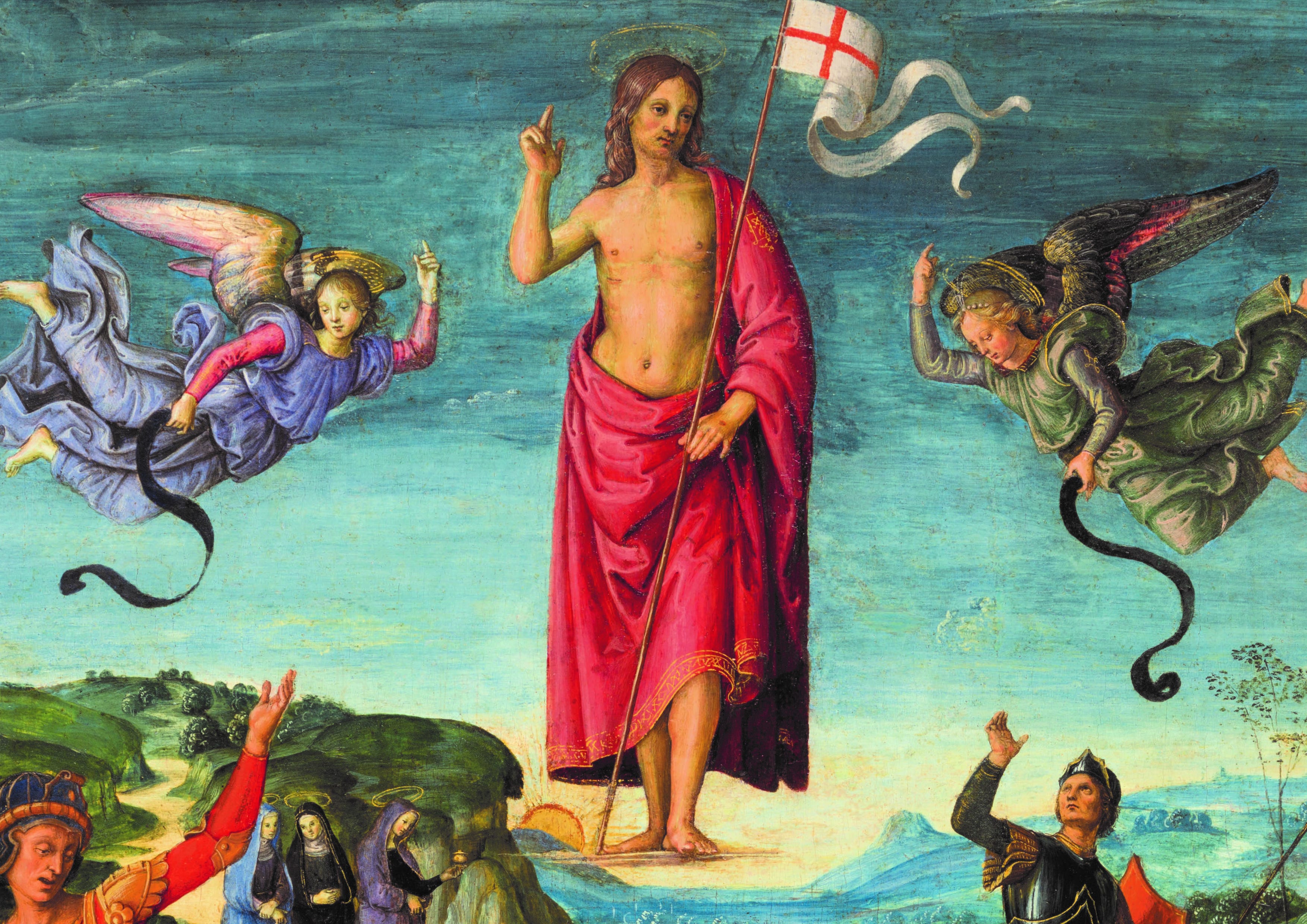
You see, in spite of his relentless pursuit of progress . . . one of the greatest quirks of all with Raphael is that his very first painting (Likely completed when he was just 19 years old) actually bears a striking similarity in composition to his very last work too, which was left unfinished on his easel at the time of his death.
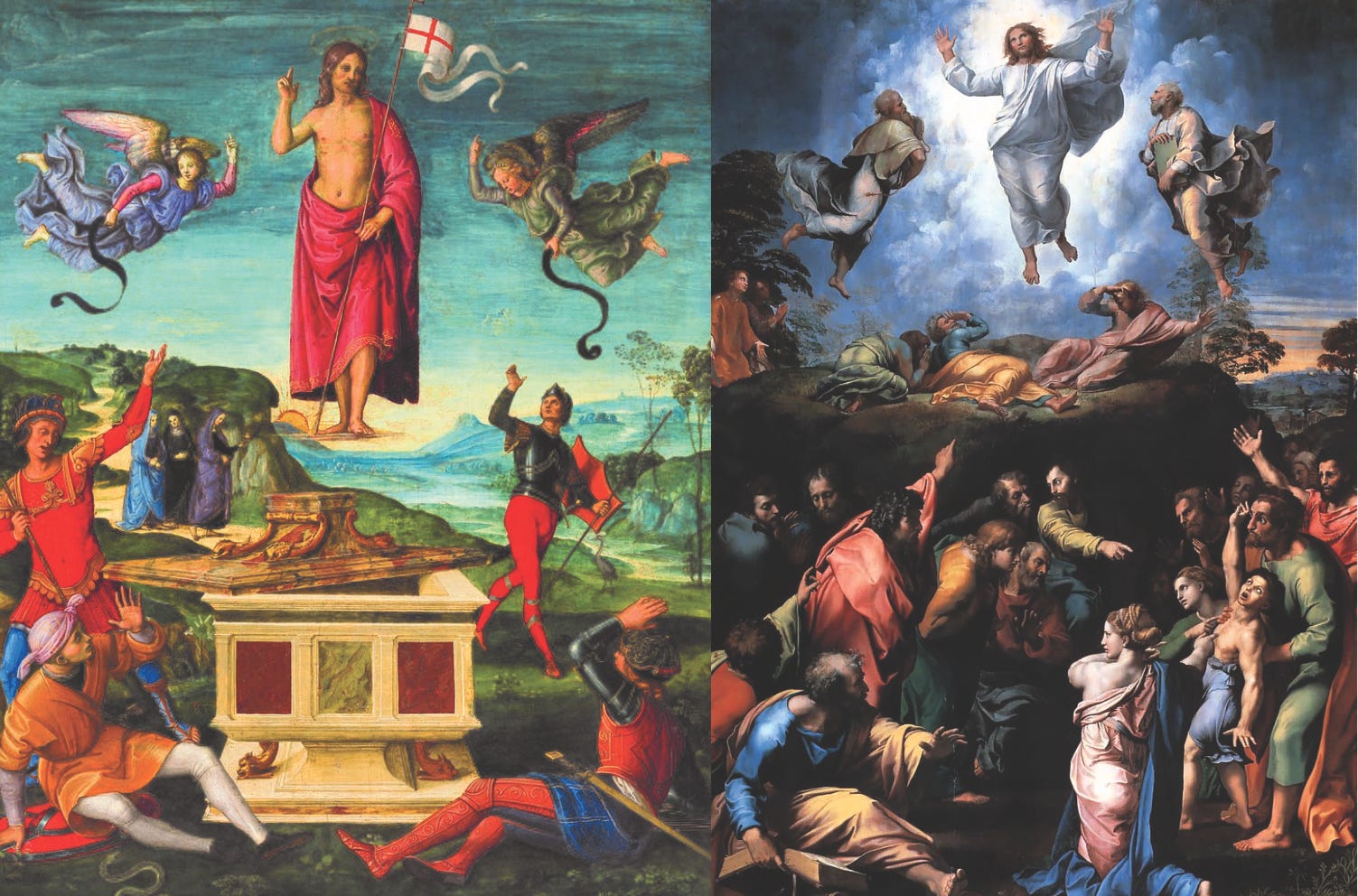
Now, of course, there is a clear difference between the two paintings in terms of their actual subject matter.
The first is a Resurrection scene - i.e depicting Christ rising from his tomb in the aftermath of his crucifixion.
And perhaps unsurprisingly, the general composition and colour scheme we see here is very similar to what we also find in works by Raphael’s teacher Pietro Perugino. (In fact, many believe this painting was actually begun while Raphael was still an apprentice in Perugino’s studio - which means that it was started when our artist was still only 16 or 17!)
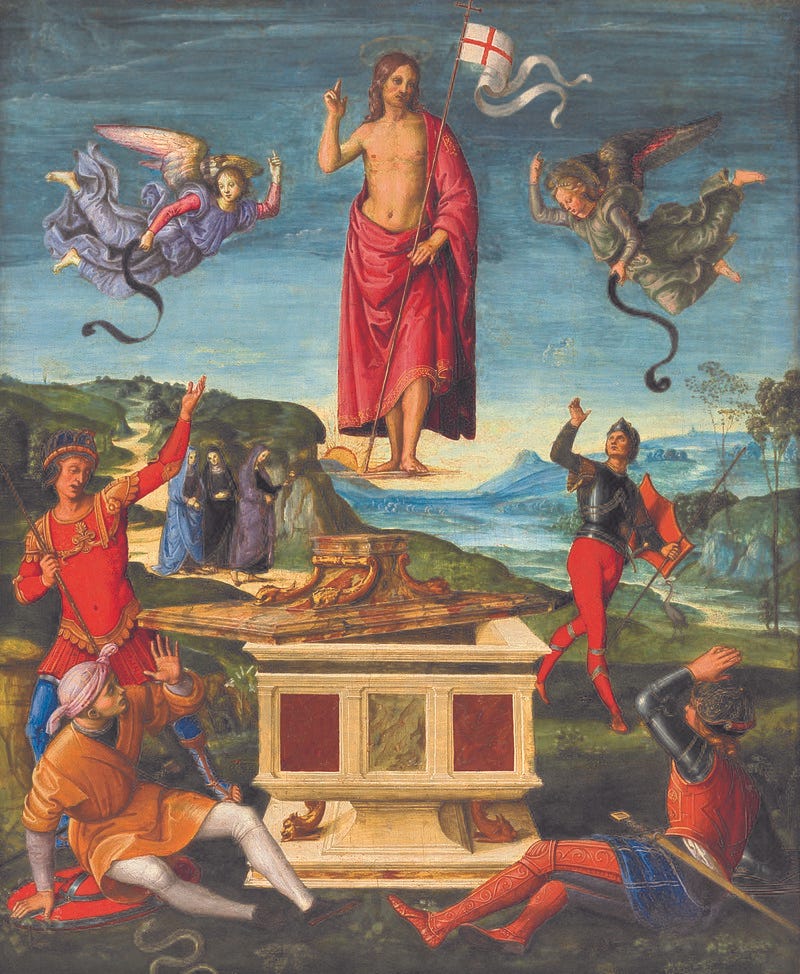
Meanwhile, in his last painting, we have a Transfiguration scene; which is based on a moment from slightly earlier in the Gospel narratives, where Jesus’ divinity is revealed in full glory (alongside the old testament figures of Moses and Elijah) to three of his disciples.
So, in that sense, the order of these works is also a little anachronistic - with Raphael painting the end of Jesus life at the start of his own career.
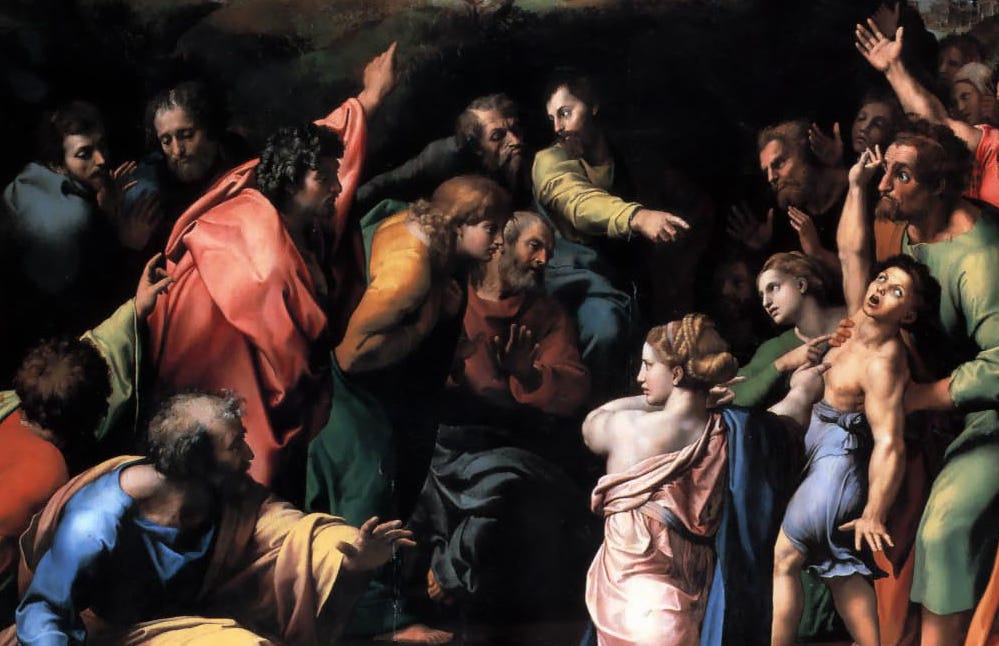
And incidentally, its worth mentioning that the Transfiguration is technically a double image too - with the lower half of the work showing a separate gospel episode where the apostles are trying to free a young boy from demonic possession. (Hence, one of them is pointing to Jesus as the only one who can genuinely save the child)
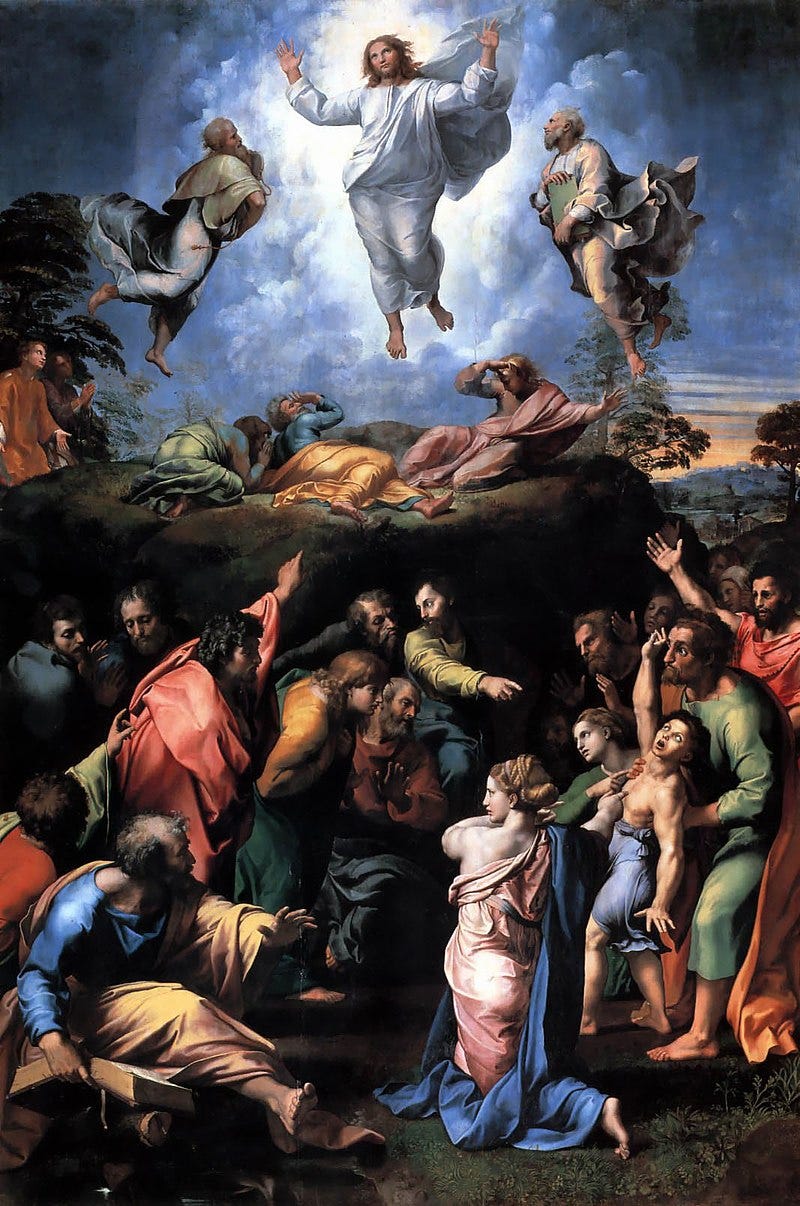
Yet still, when the two are seen side by side, the similarities in their overall structure and general composition really is fascinating.
Notice the way Christ appears floating in the centre of the work - and the height of the sky in relation to the land below - and the distinctive flat mountain top - and the two figures flanking Jesus - and the way both pictures are very clearly split into three distinct horizons (i.e a lower ground - middle action - and upper heaven).
In short, there are so many complimentary elements here, it could lead us to believe that Raphael intentionally created his final work to the exact template he had used in his first. (Though, admittedly, there no real evidence of there being a literal template - and more likely, it is just an unconscious influence)
_
But while all the similarities seem to become more obvious the more we look for them . . . there is also so much to admire in terms of Raphael’s artistic development here too.
Look again at his Transfiguration in particular.
His lighting has become more dramatic. His colours have become bolder. His figures have become more realistic. And he is now confident enough to populate this work with a cast of 27 different characters, whereas in that early work he played it much more safe with a relatively symmetrical main grouping of seven (Plus those three women in the background)
So in these two paintings alone, we have an extraordinary “full circle moment” for Raphael. (Though, of course, it is tragic that this happened to also be the full circle of his own life too)
In the Resurrection, we see his raw talent.
In the Transfiguration, we see how that talent developed.
In the Resurrection, we meet a boy wonder who already understood how to compose a masterpiece.
In the Transfiguration, we see a fully fledged master in his own right, who had taken art to a level no-one had ever seen before, while still relying on the very same tools he had learnt all those years ago.
_
In his first masterpiece, we have the seeds of greatness.
In his last masterpiece . . . we are left with the entire garden!
As ever, an excellent piece, George, and it reminded me that not only is great art a feast for the eye, but it can also educate. In first coming across Raphael's 'Resurrection', in those days when search engines were called libraries, I wondered why Christ was holding the flag of St George, not realising that it was also a symbol of the resurrection. That knowledge explained to this late teenage youth why the wonderful Covent Garden pub, the Lamb and Flag, is so named. By then, I'd drunk many a pint in that hostelry before realising its name symbolised Agnus Dei carrying the resurrection flag. Always lots to learn from art. Hope you have a good weekend.
Great discussion and an excellent juxtaposition, for sure. In the earlier image, Christ appears to have a pancake stuck to his feet, a most certainly undesirable circumstance if there ever were one. No wonder he looks a bit stiff (right arm half-raised) and perhaps uncertain of Himself. In the final painting, though, he has become an absolutely profound expression of freedom. He's not merely defying the laws of gravity -- he's dancing that defiance, cut free from the bonds of everything imaginable other than the Divine. And his dance has gained the power to draw others into the same state of weightlessness. It's Raphael's own transformation from talented pupil to a true, full-blown artist, and no doubt about it.