
Michelangelo - Sistine centre panels
Please put aside a little extra time for this article today, because we are really going there!

What Michelangelo achieved in his fresco painting on the ceiling of the Sistine Chapel is so much more than just an iconic artwork.
A bona fide wonder of the world, and a testament to the sheer magnitude of creative genius which can exist in the heart of one man . . . it is a work which leaves millions of visitors every year completely breathless, just the same as all who have been lucky enough to see it in person over the last 500 years since its completion.
_
So of course, I cannot hope to do proper justice to a work of this magnitude within the confines of a single newsletter here.
But still, as many of you longer term readers of Art Every Day will know, I do like us to return to the Sistine Chapel every so often - if only so we can cover a few of the different details or elements in this truly epic masterpiece.
And today, I want us to focus our gaze specifically on the 9 central panels of Michelangelo’s ceiling - all of which cover important moments from the biblical Book of Genesis. (Although, of course, one of these paintings in particular is also arguably one of the most famous images of all time!)
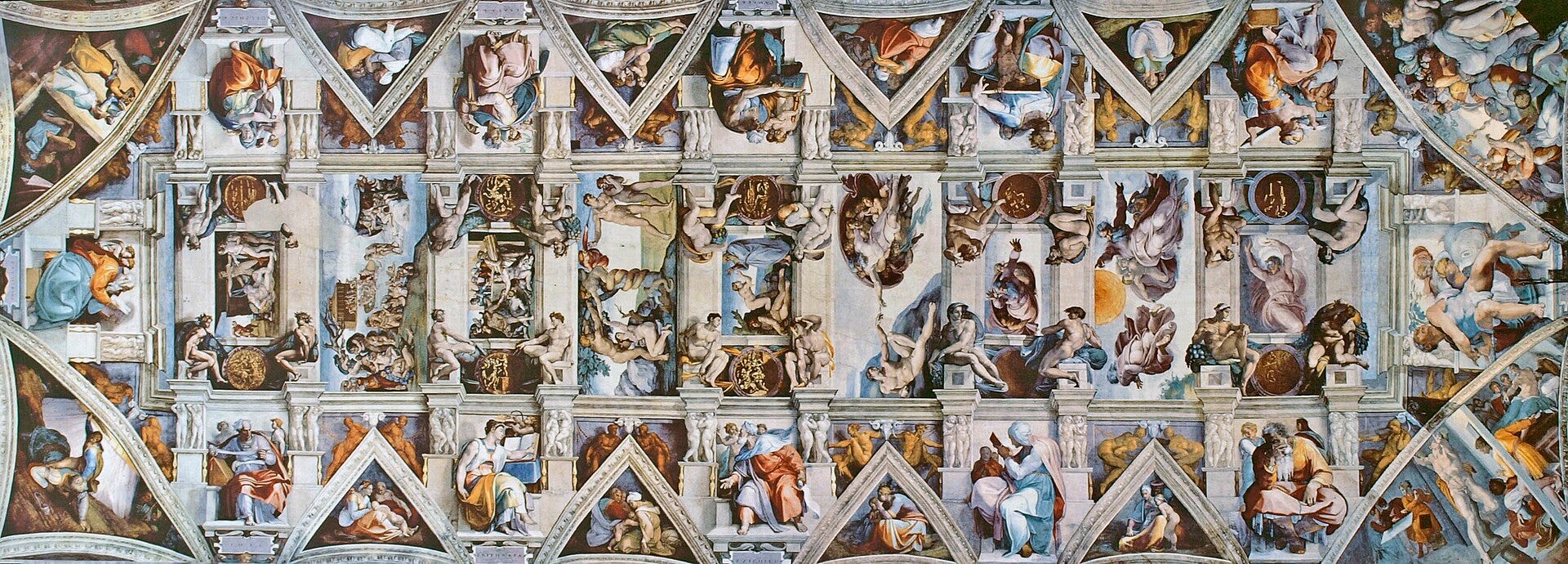
Now, if we were all standing together at the Sistine Chapel itself today - the most logical way of approaching this work would be to start with the panels nearest the altar wall, and to then follow this narrative along in the direction of the main door. (i.e reading the work from right to left in terms of the view seen above)
This way, we get to see Michelangelo’s interpretation of the Genesis narrative unfolding in chronological order - starting with God Separating light from darkness and creating our world, before finally ending with the fall of man in the garden of Eden and the final scenes depicting Noah and the Flood.
But while the vast majority of tour guides and historians always follow this direction of interpretation. . .something many people don’t realise is that this was actually not the order in which Michelangelo created these works.
In fact, Michelangelo actually completed the central panels in the exact reverse order - starting with the depictions of Noah and the flood.
So at risk of breaking all the rules of Art History today, this is also how I want us to start our own viewing too - because by approaching these panels in the order they were painted rather than in their narrative sequence, we can gain a fascinating new insight into Michelangelo’s own working methods, and how the great man actually changed his compositional style mid way through working here.
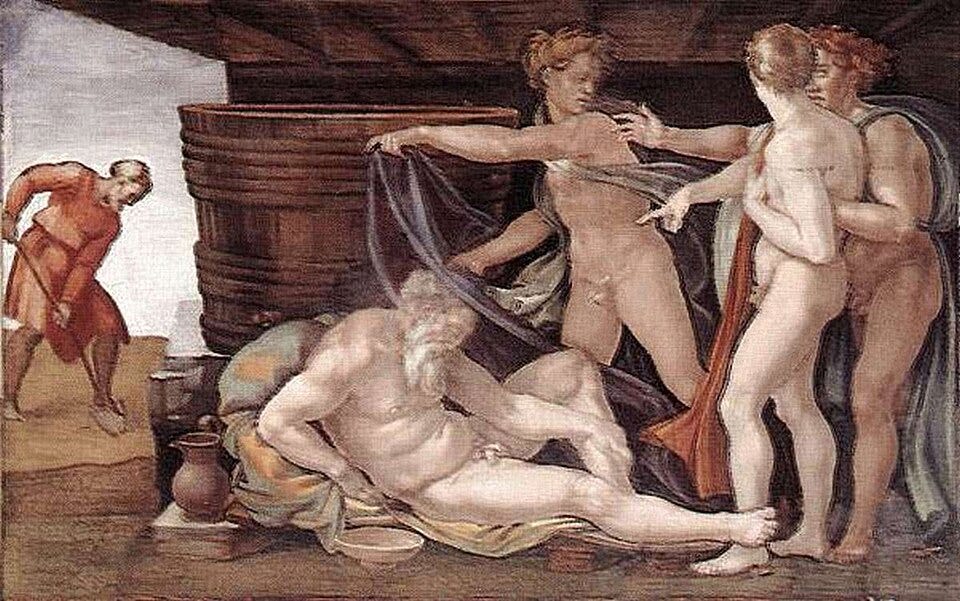
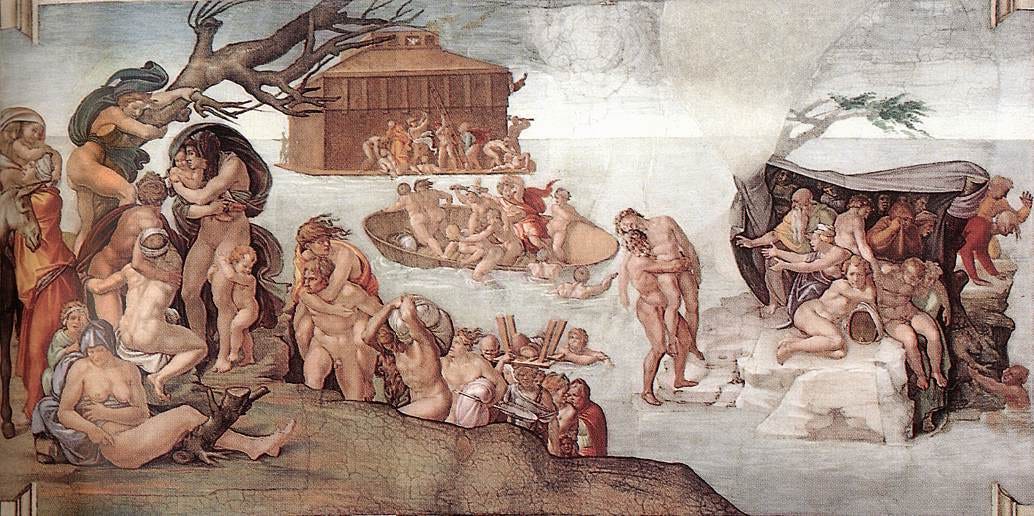
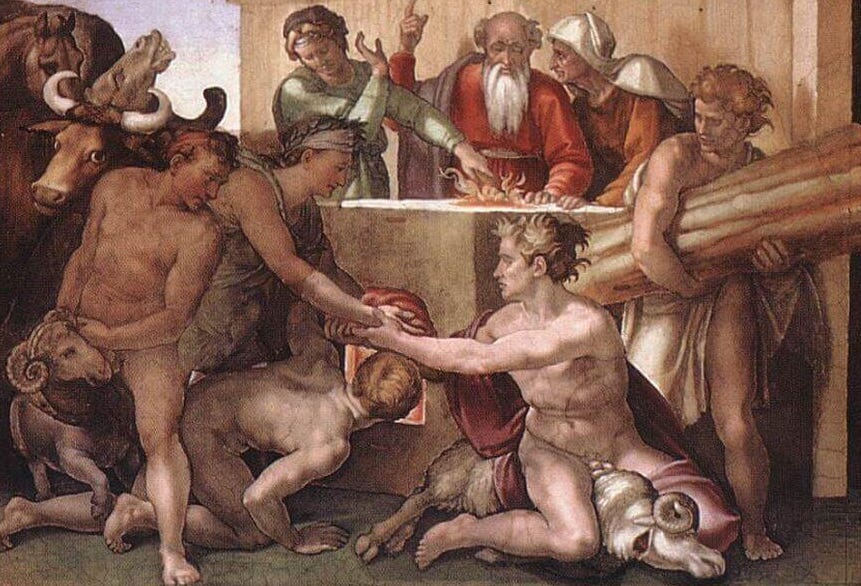
You see, in these earliest three works seen above, we have scenes which are quite densely populated, and which follow many of the standard renaissance practices of the time in terms of framing a central cast of figures within a surrounding landscape.
But while this manner of composition works very well in the context of smaller paintings intended to be hung on a wall . . . naturally, painting on a ceiling is an altogether different prospect.
And soon enough, Michelangelo himself started having some serious doubts about how suitable these pieces really were for what he was trying to achieve.
_
From close up, they looked fine. (Indeed, to anyone who did not share Michelangelo’s level of perfectionism, they would appear absolute masterpieces in their own right!)
But when viewed from the floor below - our friend couldn’t help feeling that all three of them seemed “too busy”. Or that his figures were “not strong enough” . . . thus, it gave the impression that they were melting into each other, or appearing “lost in their own landscape”.
So, for some time, he actually seriously considered scrapping these first three panels altogether, in order to start from scratch.
However, as things turned out, an entirely different drama was soon to affect the course of his creation too.
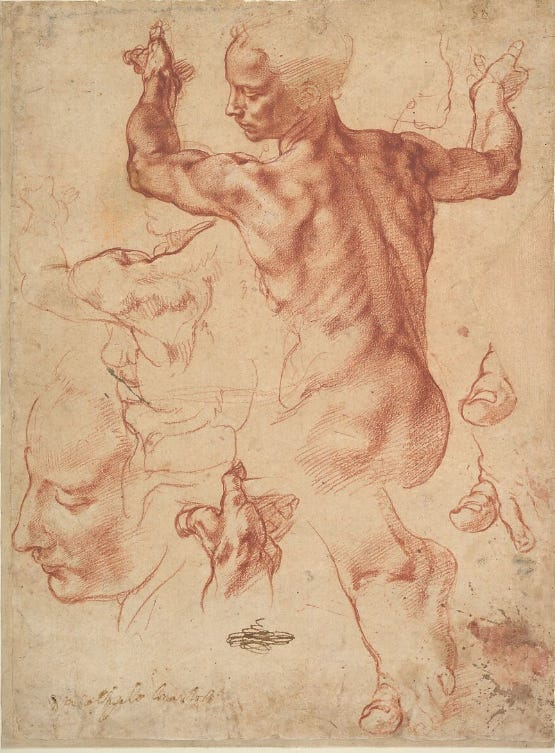
From the outset of this project, Michelangelo had always had a somewhat tempestuous relationship with his commissioner, Pope Julius II.
But as work progressed, the tensions between the two men continued to rise, due to the Pope’s general tendency for interfering, or for arriving unannounced with visitors wishing to see a sneak preview of Michelangelo’s fresco (when, in reality, the great man always vastly preferred to be left alone with his work until it was complete)
_
Plus, it also didn’t help their relations when Julius decided to also employ Michelangelo’s great rival Raphael on a painting project for the room directly next door to the Sistine Chapel.
Hence, with his frustration finally reaching a boiling point, Michelangelo abandoned his work at the Sistine Chapel and briefly left Rome altogether - telling the Pope that he would never return again, unless Julius sincerely promised to stop all his interfering and endless demands . . . and, most importantly, to also stop suggesting that perhaps Raphael could come in to help with painting the Sistine ceiling too!
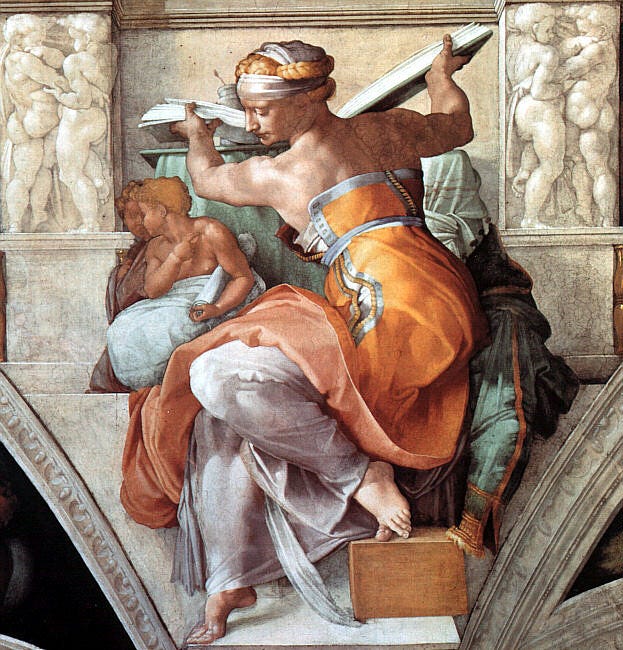
Fortunately, after a brief little stalemate between the two men, the Pope did relent.
He agreed to let Michelangelo proceed again in his own way, without any more interferences. And, as such, the artist was finally able to pick up again where he left off. Only, this time, he was returning with a whole new idea for the rest of the work.
_
During his time away, he had decided that those first three panels could stay “imperfect” as they were. (Mostly because he did not want work for the Pope even longer than necessary as a result of starting the whole thing again!)
But as for the remaining six panels . . . Michelangelo now devised an entirely different compositional style.
Moving away from those more traditional/ densely populated narrative scenes . . . he now crafted much bolder schemes, where the number of characters were reduced, and the individual figures were painted larger, and the surrounding landscapes were brought down to bare minimum details.
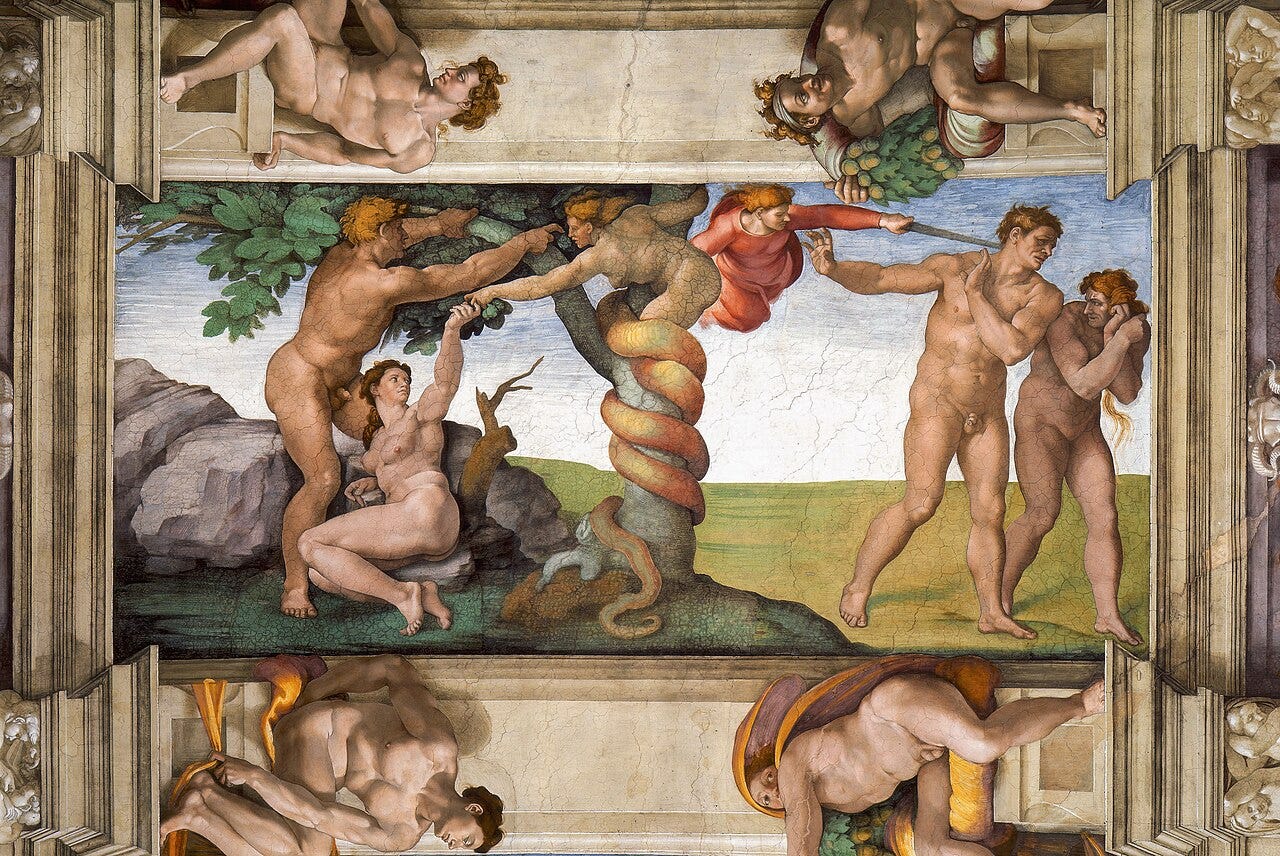
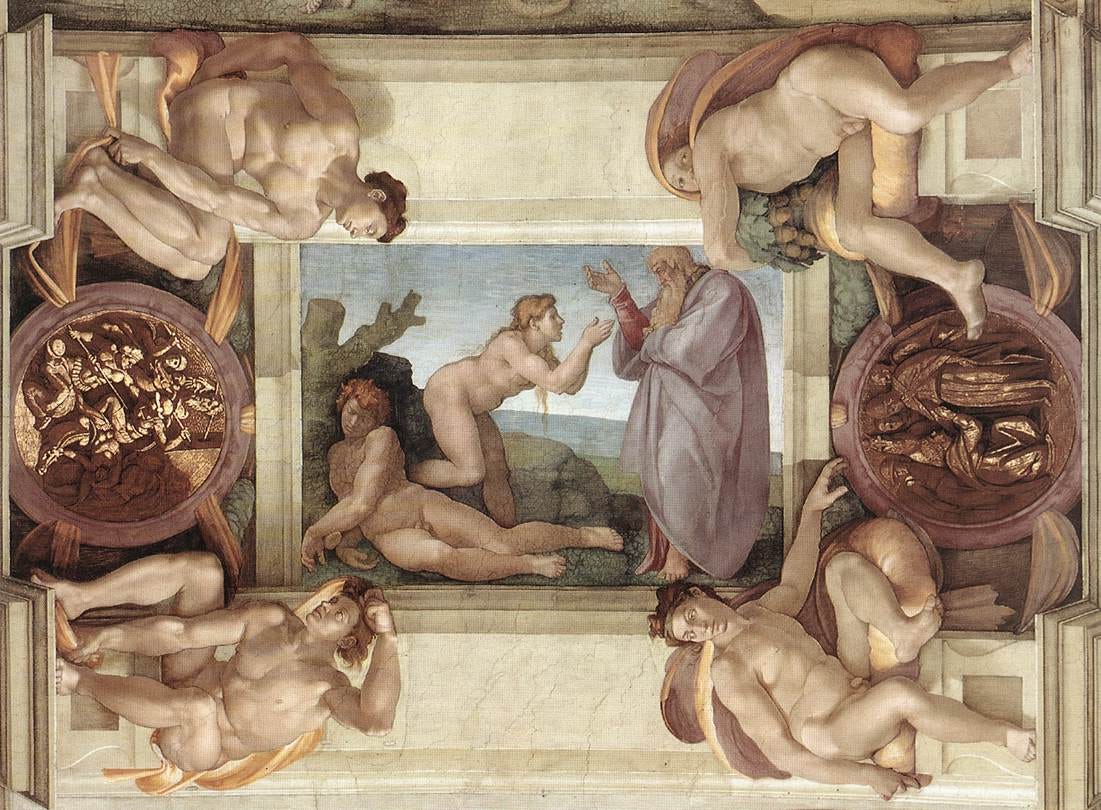
This led to a greater sense of power and of immediacy in each panel - with each character having much more of a dense/sculptural weight to them.
Plus, when seen from ground level too - the scale of each figure means that they stand out much clearer than in those first three efforts.
So to use an analogy, we might say that Michelangelo’s first three panels of the Sistine chapel are like novels - whereas, in the remaining six, he aims for something far closer to poetry instead (i.e, seeking to say as much as he can, with as few “words” as possible)
And this idea is perhaps no more apparent than with the most outstanding element at the centre of this sublime masterpiece . . . The Creation of Adam.
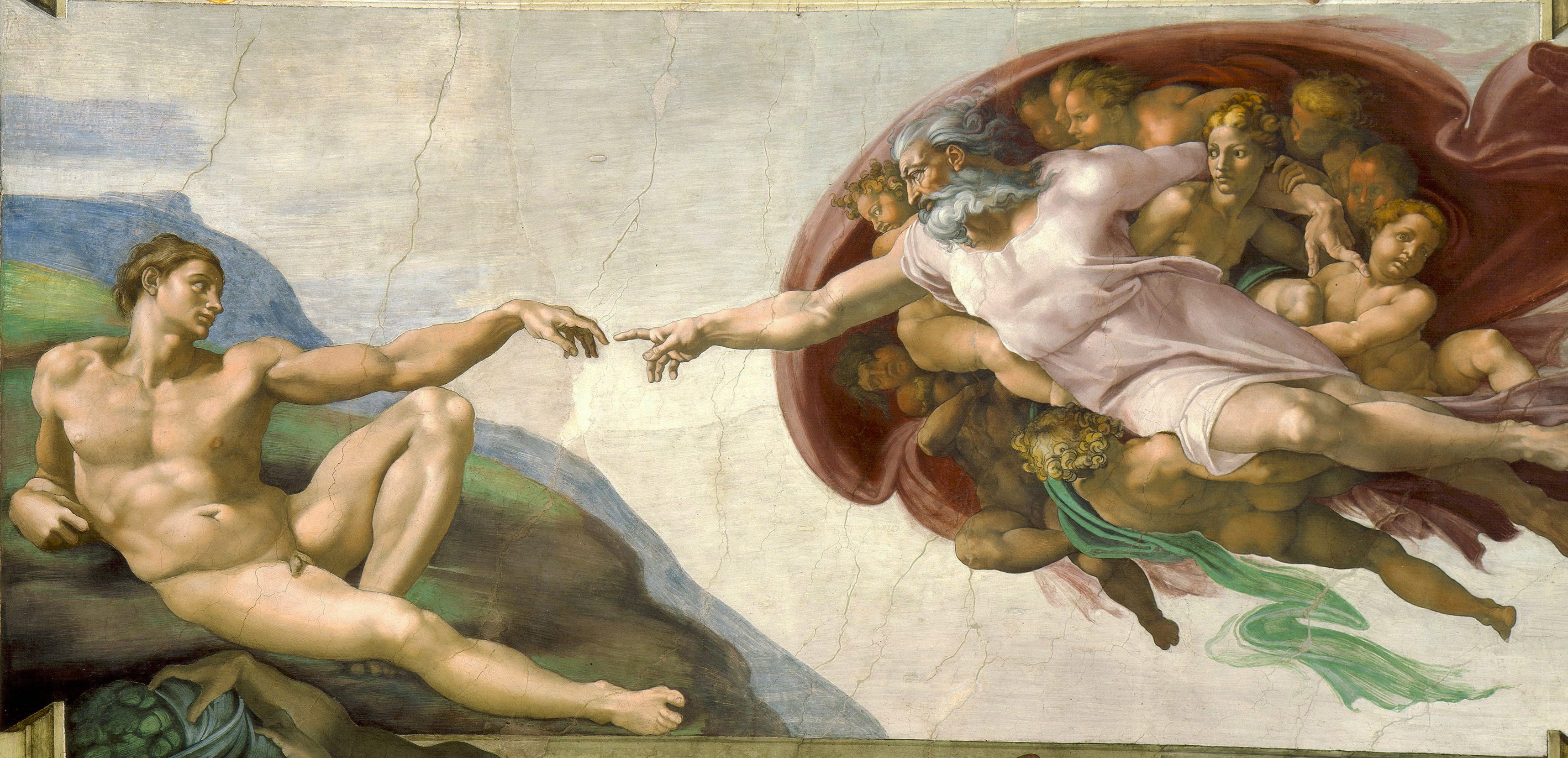
Here, Michelangelo’s newfound style reaches its absolute pinnacle.
God and Man reach out for each other in the midst of a semi-abstract landscape. . . their fingers not quite meeting. as a select band of heavenly figures watching on closely from behind the creator.
In a way, it is so simple.
Yet, at the same time, it is so utterly electrifying too.
And indeed, it is the kind of work which has a kind of universal power to it . . . such that it can inspire awe and wonder even for viewers with no religious belief or no real interest in art history at all.
_
But as mentioned at the beginning of this article - my words here today will never be enough to do justice to a work like this.
So, the best I can say for now is that this is such an important moment in Michelangelo’s life - not only because of how it changed the course of art history, but also for how it represented a change in his own ideals as a painter too.
Hence, as we move from this high point into the final three works in this series - we see Michelangelo still simplifying and stripping things back even further.
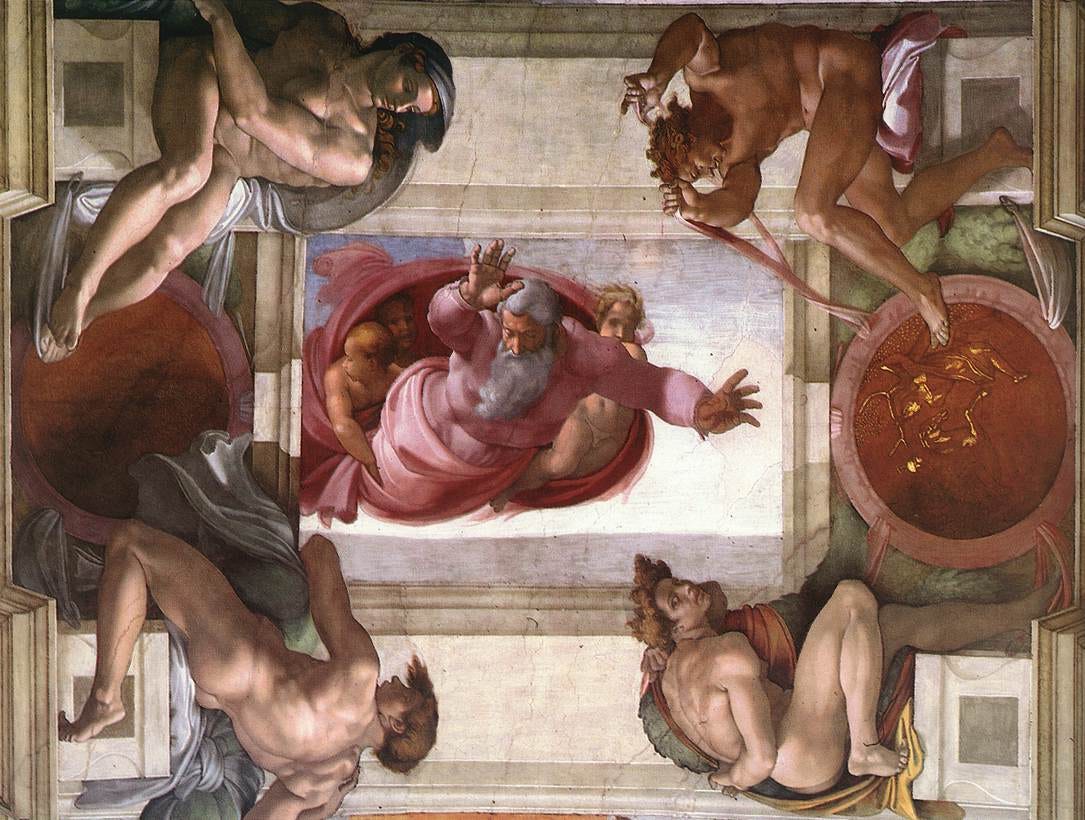
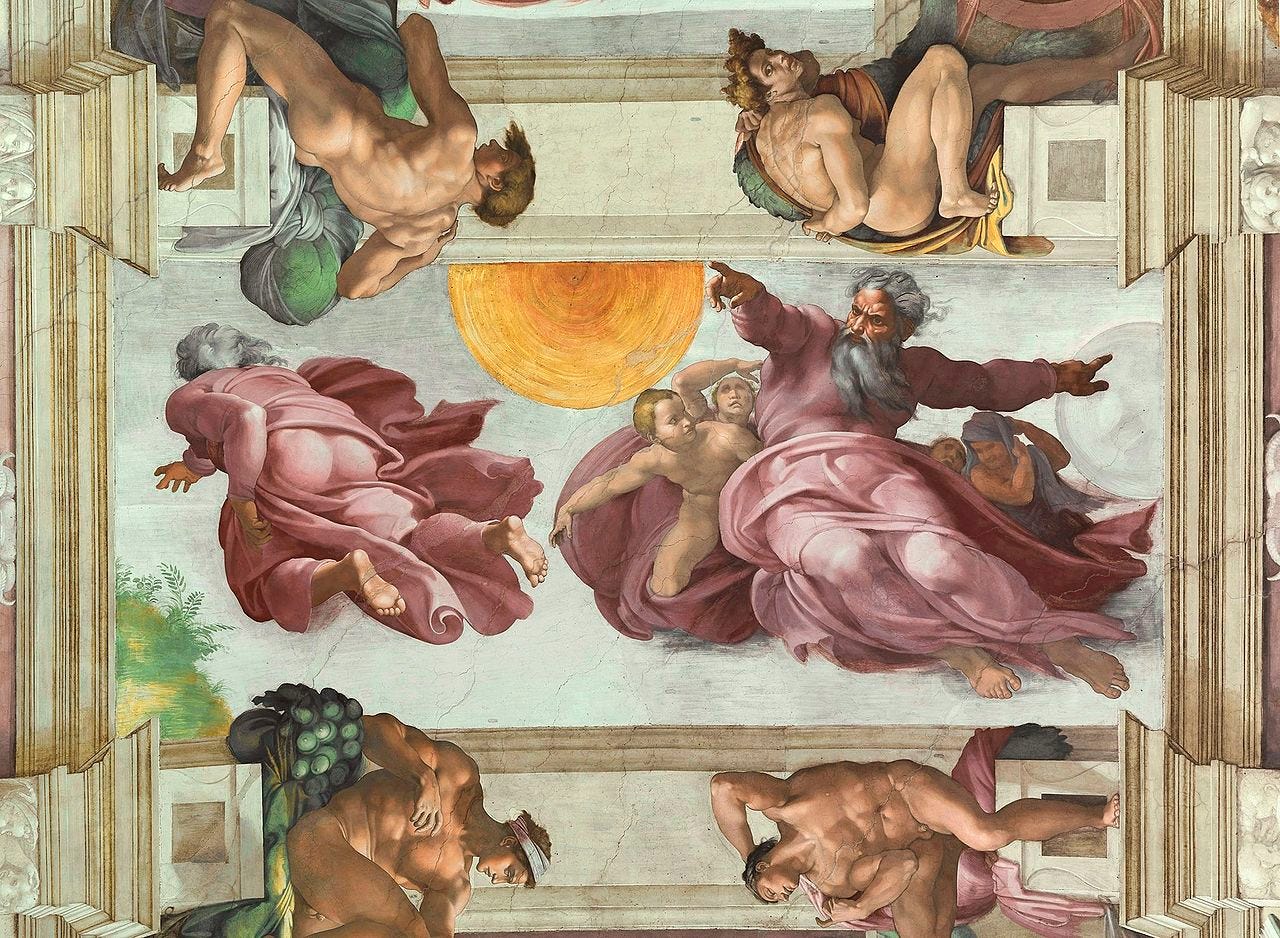
In these final works, that imposing figure of God takes up even more space within the panels - while the surrounding landscapes become so abstracted as to be almost non existent. (Which in itself is rather fitting for capturing this idea of the world not being fully formed yet in the early days of creation).
_
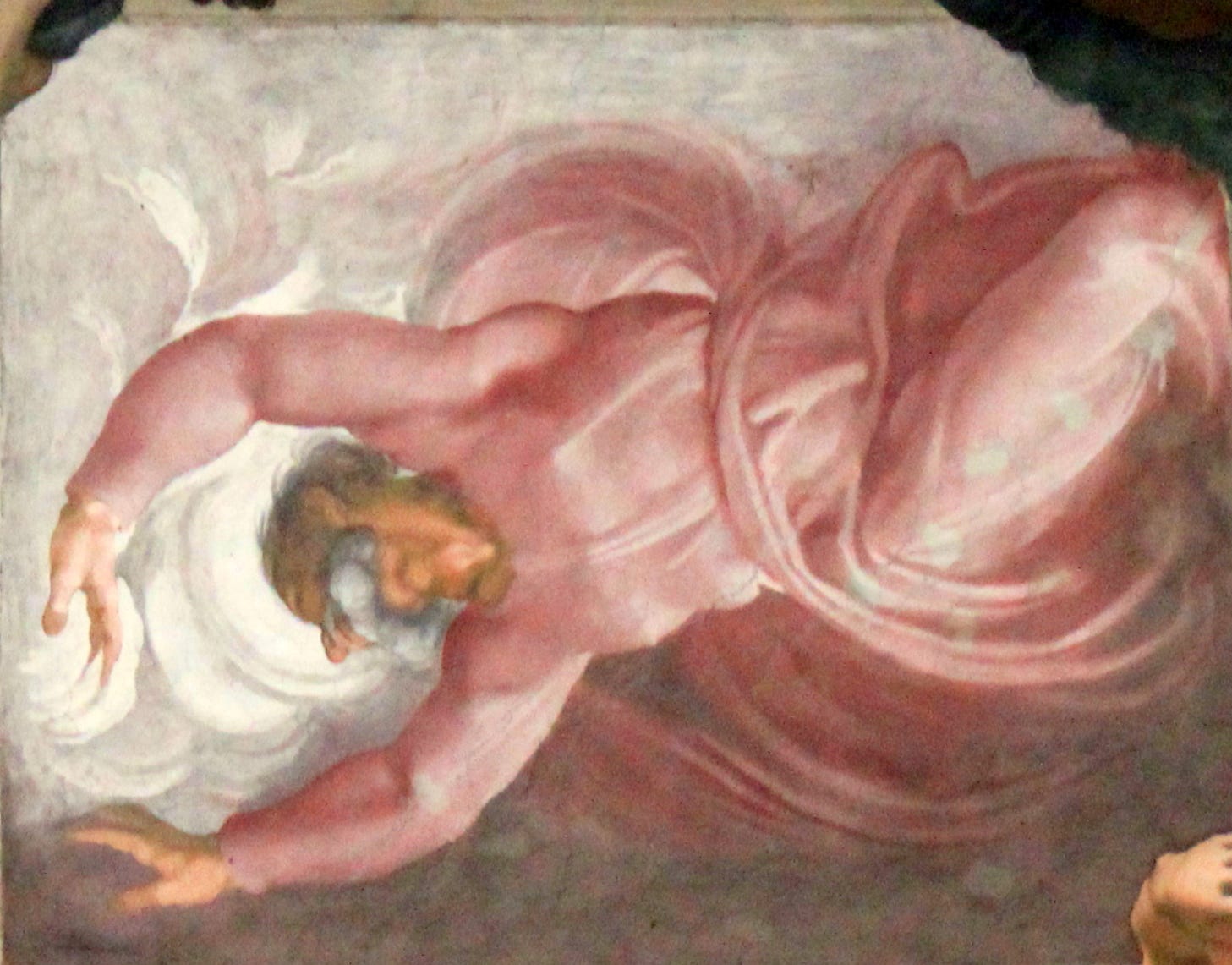
And as we finally reach the very last painting in this cycle - we see the full extent of that shift from where we started.
Here, Michelangelo has reduced his entire narrative to a single figure.
The creator of all - seen at the very moment of separating light from darkness - with his pink rove swirling and pulsating with such energy, we can almost hear the crack of thunder echoing all around us.
It takes a great deal of work to research and write long form articles like this - and as a writer with no other means of funding/support, your contributions really do play a vital role in helping to keep this newsletter going.
Truly superb. So engrossing that I missed my train stop and so good that I didn’t care. Thank you as usual!
What a wonderful tour George and I think I've shared before that sadly at the time I didn't appreciate that ceiling as much as I should, having seen so many magnificent ceilings on the way to it. What the Vatican should do in my opinion is offer a 'palete (palette) cleanser' of a 5 minute timeout in a darkened room and then let people into the Sistine.
By the way I discovered on my Caravaggio travels that he modelled the hand of Jesus in 'The Calling of St Matthew' on that of Adam on the Sistine Ceiling as a tribute to his namesake. The hand is reversed but clearly is the same.
Given Caravaggio's reputation I found such an action quite touching.