
George Frederic Watts - Hope

If we were to imagine an artwork that seeks to symbolise the concept of “Hope” - perhaps we would imagine a painting of a rainbow, or of sunlight breaking though storm clouds, or of people coming together as a community, either to celebrate the beauty of life, or to pray for better days.
_
But with today’s masterpiece by George Frederic Watts, we have none of these things.
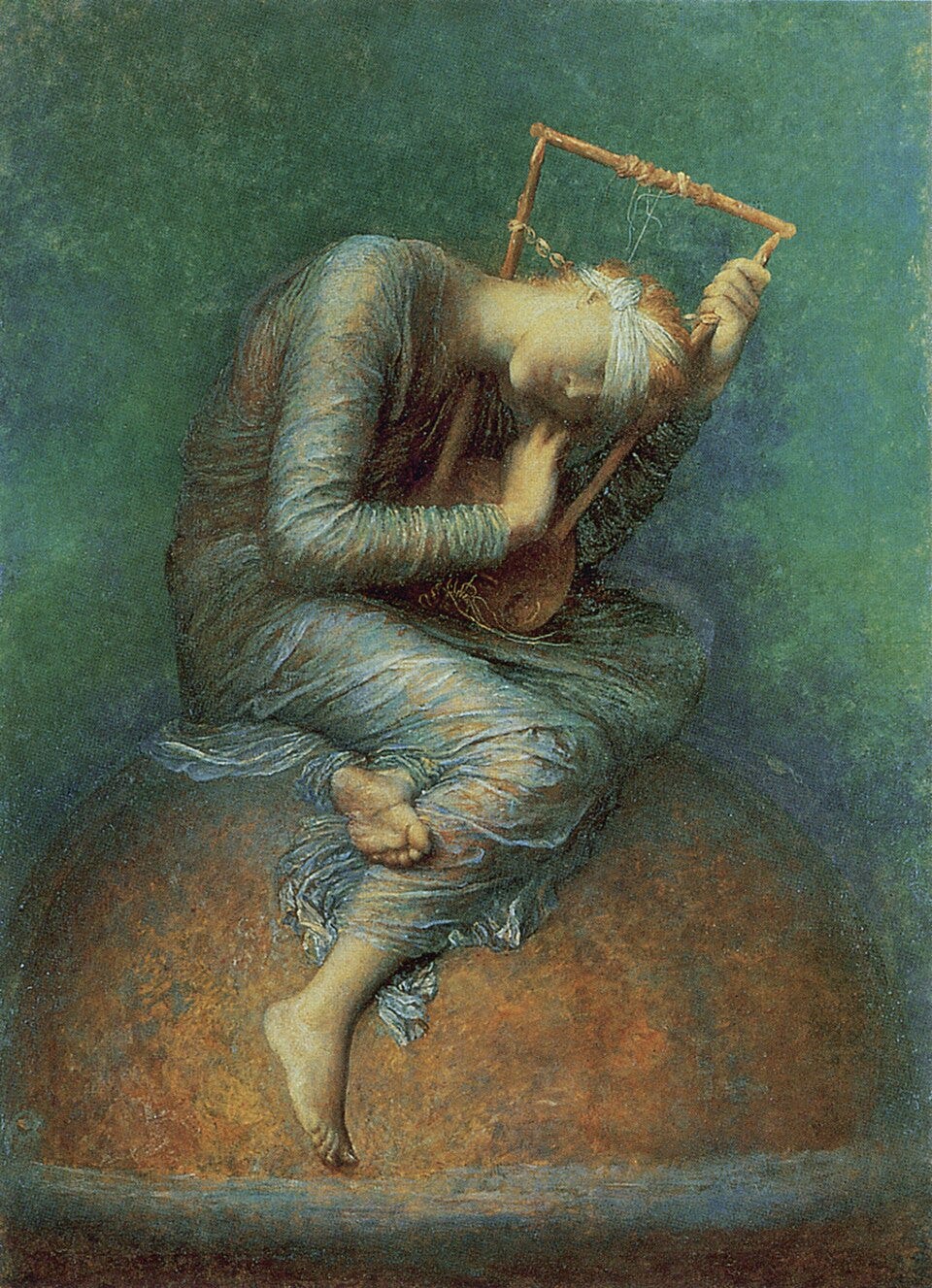
In fact, on first glance, it seems to represent the total opposite of its title - and with our blind girl sat all alone, plucking the fragile last string of her broken lyre, we appear to have the very embodiment of hopelessness instead.
Yet perhaps it is the sense of despair and the immense sadness in this work which actually speaks most powerfully of the idea of hope too.
_
After all, hope itself is not always beautiful - and certainly, it is not always easy.
Sadly, in every ordinary life, there is an extraordinary amount of pain. And as such, the times when we may need hope the most, are often the times when we feel as if we are in an apparently hopeless situation.
But with all that in mind - Watts is not necessarily painting this girl as a victim per se, nor as someone to elicit our sympathy. (Though of course, anyone with a heart would look at her, and feel so heartbroken for the situation she is in.)
Rather, he wants us to see her as a source of inspiration instead - because even in her isolation, and having lost her own sight (i.e being in literal as well as emotional “darkness”), and with her treasured instrument all but broken . . . still she is continuing to play whatever music she can, even if it must be on her very last remaining string.
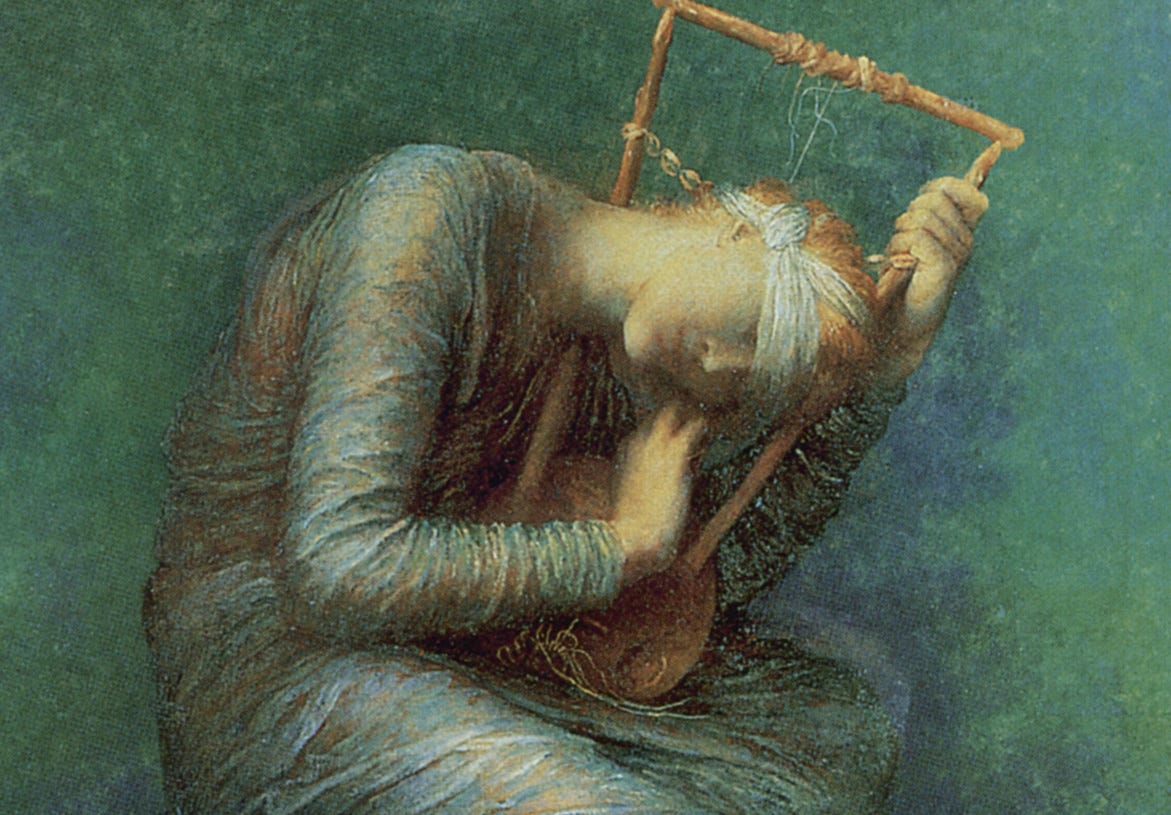
In other words, with every reason in the world to feel utterly beaten by this life, our young girls is still trying to create something beautiful - or, at least, is still determined to cling on to whatever small joy she can experience.
And for that reason, I feel she really is a wonderful guide for all of us who may be going through hard times - no matter if this is through personal circumstances, or in a wider sense with the state of our modern world.
_
She shows us that we must hold on to what we love - even if it is a single note played on a broken instrument.
And that we must hold on to hope - just as we hold on to life- even in times when it feels as if it would be easier to let go.
Bonus Works
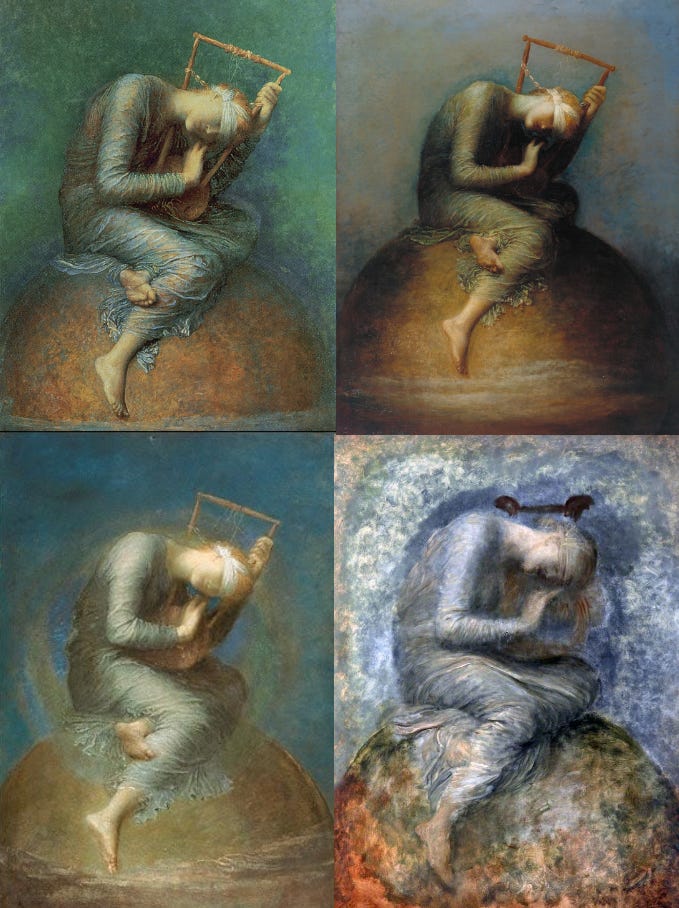
Incidentally, George Watts made a few more versions of this work after the original, as he wanted to sell them to private collectors. (He had already promised to donate the original version “to the nation”, along with many other masterpieces from across his career.)
So while the piece we covered above is the original “first version” - I couldn’t resist the chance to include three other versions here too, in order to show how he subtly changed the colour tones of this composition over the course of time.
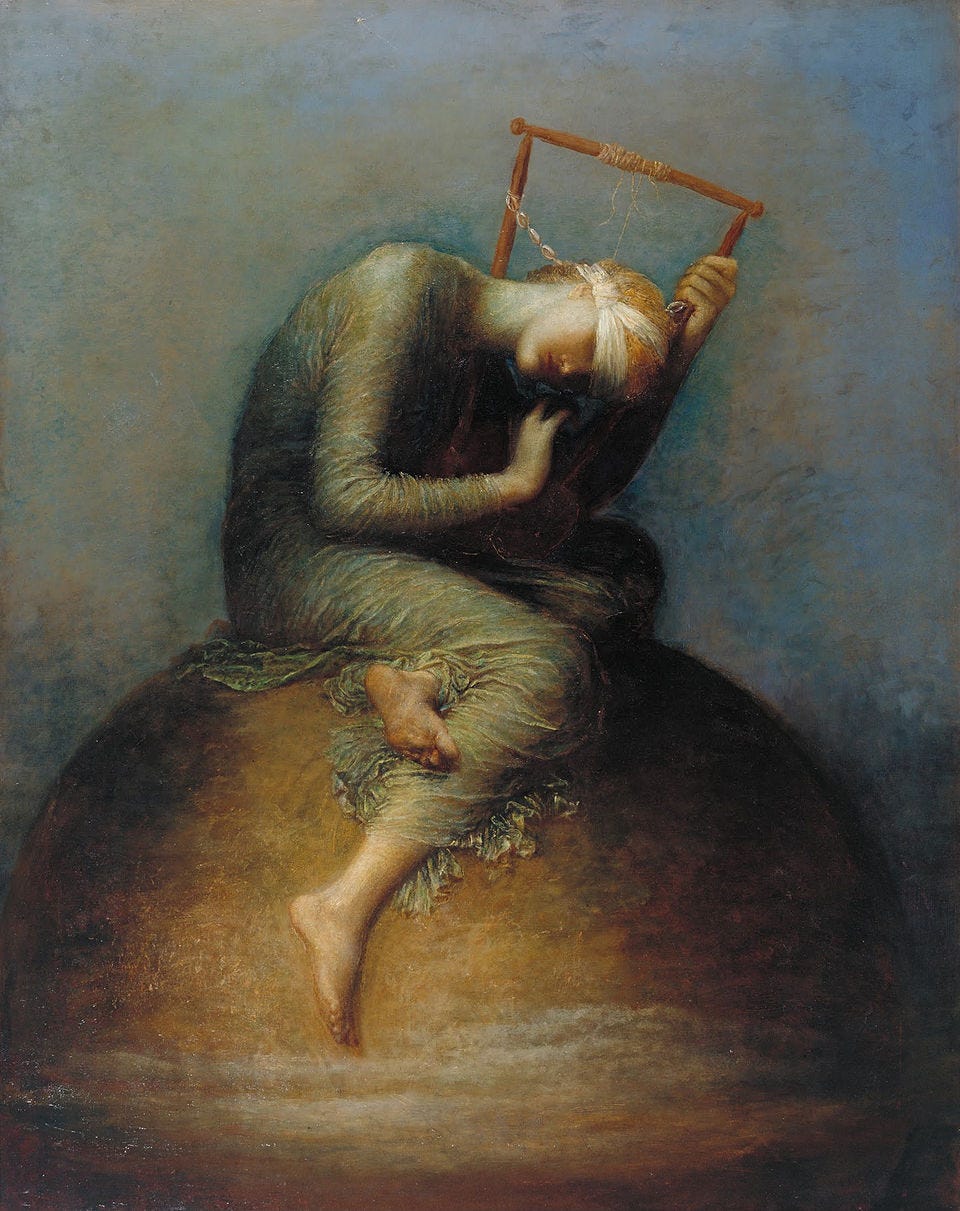
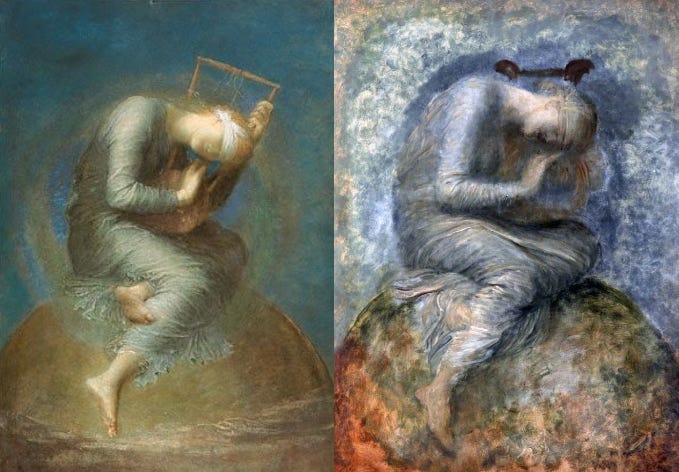
- All four versions of Hope together for full comparison
I found this print at a local antique shop in Texas and that lead me to finding out all I could about Watts and eventually taking a pilgrimage to visit his studio and Gallery soon after it was restored and opened in 2016. If you ever get a chance, it’s a wonderful place to visit and so is Watts Cemetery Chapel down the road. It is glorious and was designed by artist, Mary Fraser Tytler, who became Watts wife.
I can’t thank you enough for crafting these daily art history missives. They are such a bright spot. Hope made me audibly sigh, it is a fitting title for Watt’s painting.